On TN Govt Laptop - Dear GoTN & C-DAC, Will You Listen?
Tamil Nadu Chief Minister M.K. Stalin has rolled out a govt. sponsored laptop scheme named "Ulagam Ungal Kaiyil" targeted at students from government schools & colleges. Here is what we think about it. No, it's not about the labels & stickers.

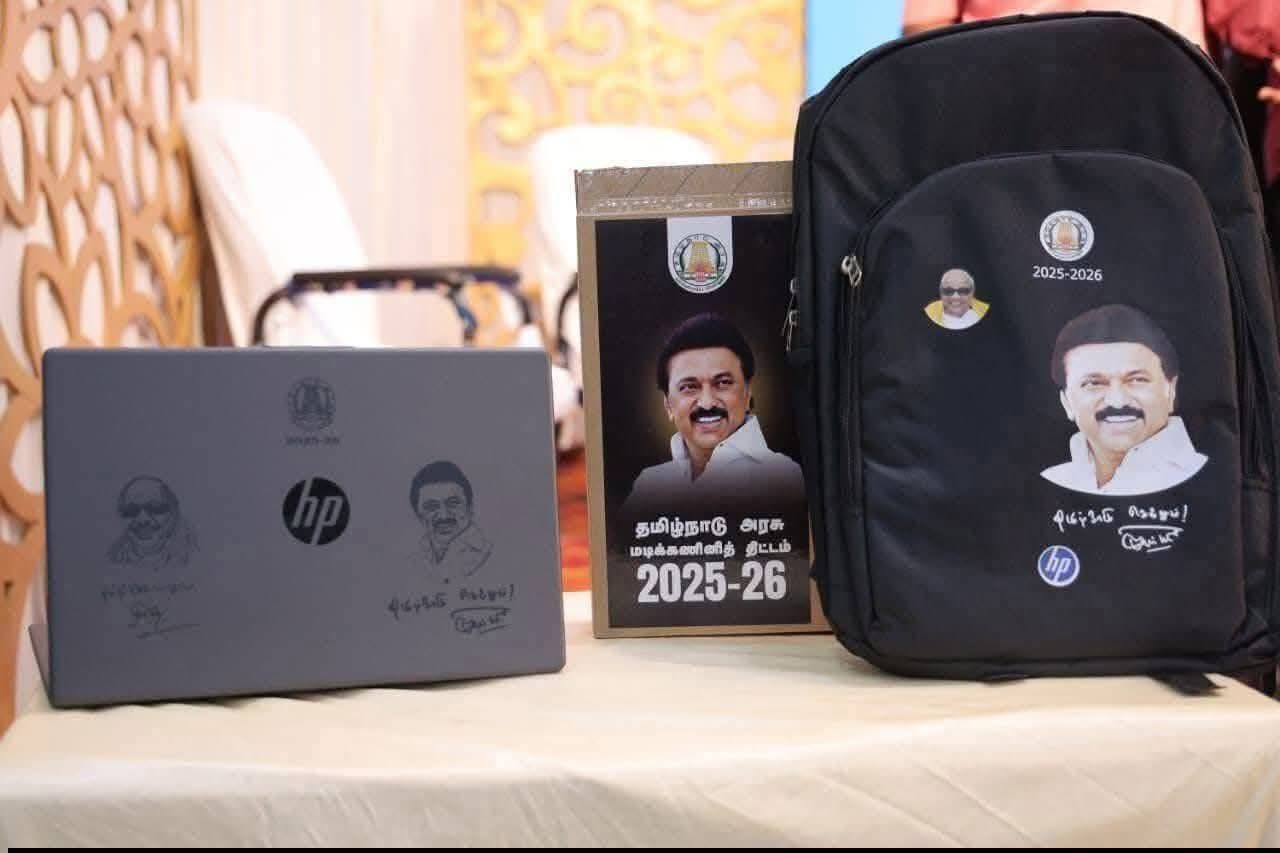
Tamil Nadu Chief Minister M.K. Stalin has rolled out a govt. sponsored laptop scheme named "Ulagam Ungal Kaiyil" targeted at final year students from government colleges. Here is what we think about it. No, it's not about the labels & stickers.
Back in 2011, when the idea of government sponsored free laptop was introduced for the first time in Tamil Nadu, ELCOT (ELectronics Corporation Of Tamilnadu) floated a set of technical specifications (software & hardware requirements).
FSFTN welcomed the state government's move as an important step towards 'bridging the Digital Divide'. However, our executive committee members met the minister of Information Technology and submitted our concerns regarding the exclusion of Free and Open Source (FOSS) operating system & tools. We highlighted the long-term benefits of integrating GNU/Linux operating system & the open knowledge opportunities the FOSS ecosystem provides to students.
Our Concerns - 2011
- BOSS GNU/Linux, a closed & proprietary GNU/Linux distribution maintained by C-DAC(NRCFOSS), was included in the specifications and came pre-installed along with Windows OS in all the laptops.
- However, the support for BOSS was very poor. There were multiple hardware driver related issues (WiFi, Trackpad, etc,) and students didn't have a support center to fix them. Hence they had to rely on volunteer/community support online. Read the comments in this post
- On top of that, BOSS GNU/Linux lacked a modern Desktop Environment and did not appeal much to students. These were some of the short-comings.
Our Concerns - 2026
A decade and five years later, today, the government sponsored laptop scheme is back again with a renewed set of technical specs. We have learned from the press, that a total of 20 lakh laptops will be distributed in phases and a budget of Rs.2000 crore has been allocated in the first phase to distribute 10 lakh laptops.
On Operating System
The laptop comes with dual operating system. Windows 11 and BOSS GNU/Linux.
- All our concerns from 2011 on BOSS Linux still remain, mainly our reservation against it being a proprietary closed-source GNU/Linux distribution.
- Instead, Department of Higher Education can invest minimal resources to create and maintain a FOSS GNU/Linux distribution of it's own containing Education related & Tamil computing tools similar to how Govt. of Kerala, through KITE initiative maintains their own GNU/Linux distro. FSFTN will be happy to guide such a processes.
- We hope, this time, all the different hardware from ACER, DELL and HP are tested thoroughly with BOSS Linux for hardware related issues and the laptop's boot-loader is not locked. An unlocked boot-loader gives students the choice of installing a different modern GNU/Linux operating system, if they wish to.
- The freedom in computing starts with ability to change the fundamental operating system of a machine and definitely not with a closed/proprietary OS in education. Students are not mere users or consumers of technology, they are future practitioners. A practitioner cannot learn from a opaque black-box proprietary system.
On Hardware
The laptop is equipped with either Intel's i3 series (or) AMD's Ryzen 3 series processor, 8GB RAM and 256GB SSD storage. ACER, DELL & HP have bagged the tender to manufacture the laptops at the cost of approx Rs.18,500/- to Rs.21,000/-
- Karnataka state electronics development corporation, KEONICS developed and launched, KEO, a low-cost AI ready mini PC at Bengaluru Tech Summit (BTS) at an cost of Rs.18,999/-, last year.
- The development of KEO is a significant milestone in achieving technology sovereignty because, it is powered by a RISC-V processor which provides open instruction set instead of proprietary instruction sets (x86/ARM) that comes with Intel and AMD processors. By choosing this, the agency can save money on licensing costs & not locked-in to a particular vendor.
- KEONICS also procured the required electronic components directly from Taiwan and assembled this device.
- We ask, why ELCOT did not take this approach? This approach, not only saves cost, but also breaks dependency on licensed technologies from foreign companies, thus a step forward in achieving technology sovereignty.
- The three state agencies of Tamil Nadu (ELCOT, TNeGA), Kerala (KITE) and Karnataka (KEONICS) can collaborate on such a project, scale it to larger level and mutually benefit from each other which will also stand as a good example of federal cooperativeness.
- The keyboard in the new laptops are missing Tamil letters in it. The previous laptops had it. Having Tamil letters in keyboard will encourage students to learn to type in Tamil as well.
On Software
- All students get a 6 month free subscription to the AI platform 'Perplexity Pro'. We ask, On what basis Perplexity Pro is chosen and what happens after 6 month, when the subscription ends?
- Again, we would like to highlight an initiative by KEONICS. They are building an offline-first AI chat-bot/agent, BUDDH, which is trained on Karnataka State education syllabus textbooks. This will be pre-installed in the KEO PCs and will be available to school students even without Internet. Why ELCOT & Department of Education did not think about this?
- Government, instead of promoting a commercial proprietary black box tech platform, like Perplexity, to expand their market (which is not government's duty), should basically build a open-hardware based PC, equip it with a better processor to run off-the-shelf, open-weight AI models locally using FOSS LLM tools like Ollama, LocalAI, etc.
- This way, the students can tinker with AI models without losing their privacy and access to Internet shouldn't be a barrier to learning AI in first place.
- Students shouldn't be seen as mere consumers of black-box technology, instead they should be equipped with transparent technology & tools like FOSS which they can use, study how it works, modify & improve upon to actually gain knowledge required for practice. This definitely improves their employability skills.
Summary
The state apparatus has two approaches before it.
- One is to spend the public money on opaque black-box proprietary technology and be dependent on external players for long time.
- The other is to spend the public money on transparent FOSS technology, which is good for students and the autonomy of the state in the long run as it promotes technology sovereignty.
"Where there is a will, there is a way"
Will the Government of Tamil Nadu listen and change their approach for phase-2 laptops? Let's voice out.